How To Align Your Design System With Business Objectives
Learn how to connect design system work to business metrics, prove ROI to leadership, and turn your system into a measurable growth driver.
 Nezar MansourContent Writer
Your design system team ships components. Your company ships products. Those two things aren't as connected as they should be.
Design system alignment with business objectives is the practice of making that connection explicit. It means routing your roadmap, your metrics, and your stakeholder conversations through the outcomes your company actually measures. Teams that do this well get funded and grow. Teams that don't get cut or absorbed into product squads where engineers stop using the system the moment it slows them down.
The Disconnect Between Design Systems and Business Value
When budget reviews come around, design system teams often find themselves defending headcount with metrics nobody upstairs cares about: component count, adoption percentage, documentation coverage. These numbers signal internal health, but they don't answer the question a VP of Product is actually asking: what would break if we cut this team?
Why design systems struggle to show their value
The honest reason most design systems can't prove their business value is that they measure what's easy to measure. Component libraries track tokens. Documentation sites report page views. Coverage reports count the number of product surfaces using the system.
These metrics aren't useless; they tell you about system health internally. But they don't translate to the outcomes leadership already tracks. Until you can answer "what did we save last quarter?" with a number, you're living on borrowed goodwill.
The reframe is straightforward. Before a major design system initiative starts, ask: which business outcome does this unblock? Ship the answer alongside the work. If you only make the connection after the fact, you've already lost the conversation.
Translating business goals into design system priorities
Most company strategies fall into a handful of categories. Each one has a natural design system counterpart:
- Faster product launches: focus on completing the component coverage for your most-used product patterns. Fewer one-off implementations mean engineers build against the system rather than around it, and features ship faster.
- Cost reduction: prioritize bug fix propagation and eliminating duplicated UI code across teams. One fix in the system versus twenty fixes scattered across repos is the kind of math finance understands immediately.
- Market or brand expansion: invest in theming architecture and multi-brand token support. A system that makes launching in a new market a configuration exercise rather than a rebuild directly reduces the cost of growth.
- Conversion rate improvement: direct design system investment toward the patterns that touch acquisition flows: forms, onboarding steps, checkout components. Inconsistency in a purchase path is a measurable friction point, and fixing it at the system level fixes it everywhere at once.
- Faster engineering onboarding: invest in documentation quality and clear getting-started guides. A new hire who contributes at full quality in week one is a concrete time-to-productivity win that any engineering manager can put a number on.
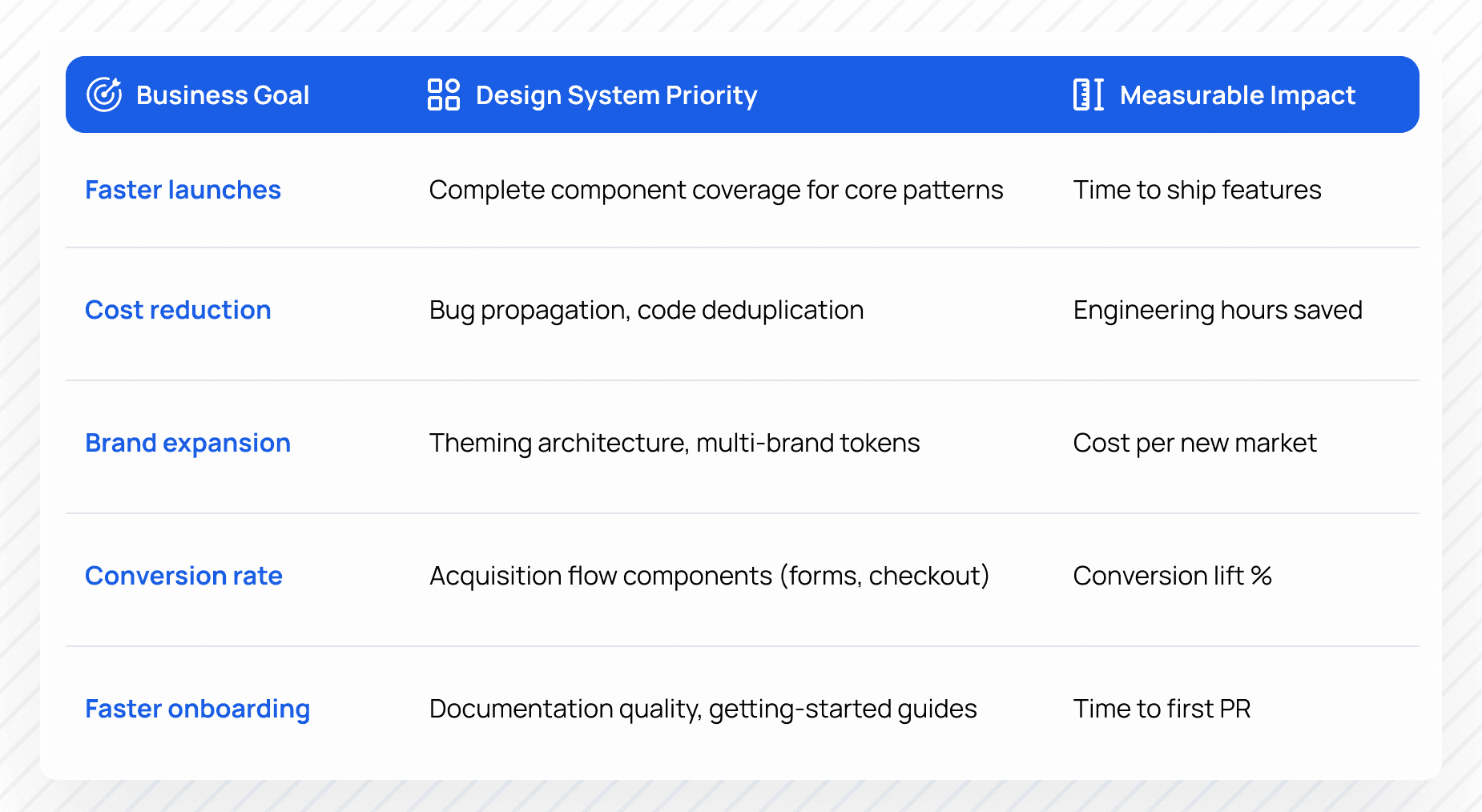
The process is simple in principle: take your company's OKRs or stated growth priorities, map them to the area of the design system that most directly affects that outcome, and make those your next roadmap priorities. What changes is the order of work, not the nature of it.
The metrics that make the business case concrete
The right metrics for a business-aligned design system are time and money metrics, not volume metrics.
A useful starting set:
- Time saved per feature: estimate how long a feature takes with and without system components. Multiply by team size and average engineer rate. Even a rough calculation is more compelling in a budget meeting than a coverage percentage.
- Defect reduction rate: track how many UI bugs originate from components that aren't in the system. If 80% of your UI defects come from the 20% of UI that bypasses the system, that single data point justifies governance work.
- Time to first PR: how long it takes a new engineer to ship their first system-compliant feature. A reduction here maps directly to onboarding cost, which is a number HR already tracks.
- Fork cost: When a product team forks a component instead of contributing back to the system, calculate what that fork costs in maintenance over twelve months. Calculate it once, and you have a standing number for every governance conversation.
A study by Sparkbox on design system business value found that the strongest ROI cases weren't built by the most technically sophisticated teams. They were built by teams that consistently tracked their own impact and translated it into business language. That's a repeatable skill, not a talent.
If you want a starting estimate before building your own tracking, Supernova's ROI calculator lets you input your team size, release cadence, and adoption rate to get a baseline business impact number. It's a practical starting point for a first stakeholder conversation or a budget proposal.
Wise: a system built to grow with the business
Wise operates across 80+ countries in multiple languages and regulatory environments. Their design system had to scale across platforms and markets without the brand fracturing every time a new region launched. When Wise added a new market, the work needed to be a configuration exercise on top of existing token architecture. A configuration, not a design and engineering project from scratch.
The business impact was framed in launch velocity: how many markets can we support without scaling the design team proportionally? That framing positioned the design system not as a cost center but as the reason global expansion was operationally viable. It directly influenced how much investment the team received.
Freshworks: when a design system hits a support KPI
Freshworks, the B2B SaaS platform, credited its Flame design system with a 28% reduction in customer service costs. The mechanism was consistent: more coherent product UIs required less support guidance, and less retraining for customers when the product changed. A design system metric became a customer success metric. That kind of cross-functional visibility is exactly what puts design system work on the radar of stakeholders outside of engineering.
Embedding the design system in product cycles
A design system that runs in parallel to product development will always fight for relevance. One embedded in the product cycle has a natural role at every stage.
Four ways to do this:
- Sprint integration: reserve a fixed percentage of every product sprint for system contributions. When a new pattern ships in a product sprint, it goes back into the system within the same cycle, not deferred to some future cleanup sprint that never happens.
- Roadmap reviews: attend product team roadmap reviews regularly. When you know what's shipping next quarter, you can front-load the system work that unblocks it before the sprint begins.
- Contribution governance: build a lightweight model where product teams contribute new components back to the system in exchange for faster design reviews. This turns the system team from a gatekeeper into a collaborator.
- Release alignment: tie design system releases to product release windows. When a major product update ships, the system update that supports it ships at the same time, not a week behind.
The result is a system that product teams can't route around, because it's where the highest-quality patterns already live.
Common misalignments and how to fix them
The most frequent places where design system strategy diverges from business strategy:
Moving too slowly for product teams: almost always a governance problem, not a capacity one. Reduce the overhead for low-risk changes. Not every new icon needs a committee review.
Building what the system team wants, not what products need: schedule quarterly syncs with the product teams that consume the system most heavily. Build what unblocks their roadmaps, not what's theoretically complete.
Success measured internally but not externally: if your stakeholder report tracks component count growth while product teams still build one-offs, you're measuring the wrong thing. Shift to tracking how often system components appear in actual product pull requests.
System wins invisible to leadership: design system impact needs a communications strategy. A short monthly digest covering time saved, bugs prevented, and launch velocity improvements keeps the system visible to the people who control its budget.
How Supernova helps you track and communicate design system value
One of the practical challenges in business-aligning a design system is that the data is spread across too many places. Adoption data lives in analytics. Time tracking lives in Jira. Documentation for health lives in your design system site. Building a coherent ROI narrative means pulling it all together manually, which most teams don't have the bandwidth to do consistently.
Supernova's design system management gives teams visibility into adoption, component coverage, and documentation health from one place, so your stakeholder report doesn't require a week of spreadsheet assembly. Supernova also offers an ROI calculator that estimates the business impact of your design system investment based on team size, release frequency, and component adoption. It's a practical starting point for framing the business case if you're building it from scratch.
For teams working through how to build a business case for a design system or figuring out which design system metrics actually matter to stakeholders, both are worth reading before your next budget review.
The systems that get funded are the ones that speak business
No design system survives on goodwill indefinitely. At some point, someone with budget authority looks at the team and asks whether it's earning its place. The teams that survive that question are the ones already having it: proactively, in their stakeholders' language, with numbers connected to goals leadership already owns.
You don't need perfect data to start. Track one or two business-relevant metrics now. Build the habit of framing roadmap work in terms of outcomes. By the time you need to defend the team, you'll already have the evidence. If you want to get ahead of that conversation, Supernova's guide to getting executive buy-in is a practical place to begin.
Give your agents a system worth following
See how Supernova documents, syncs, and serves your system in one place.