zeroheight Alternatives for Design System Teams in 2026
Six zeroheight alternatives with November 2026 pricing, a live AI agent test for tokens and Button props, and what actually moves when you switch.
 Nezar MansourContent Writer
Most lists of zeroheight alternatives are directory pages: star ratings, a feature grid, and nobody who has tested the tools. This one is shorter and starts with a live agent check.
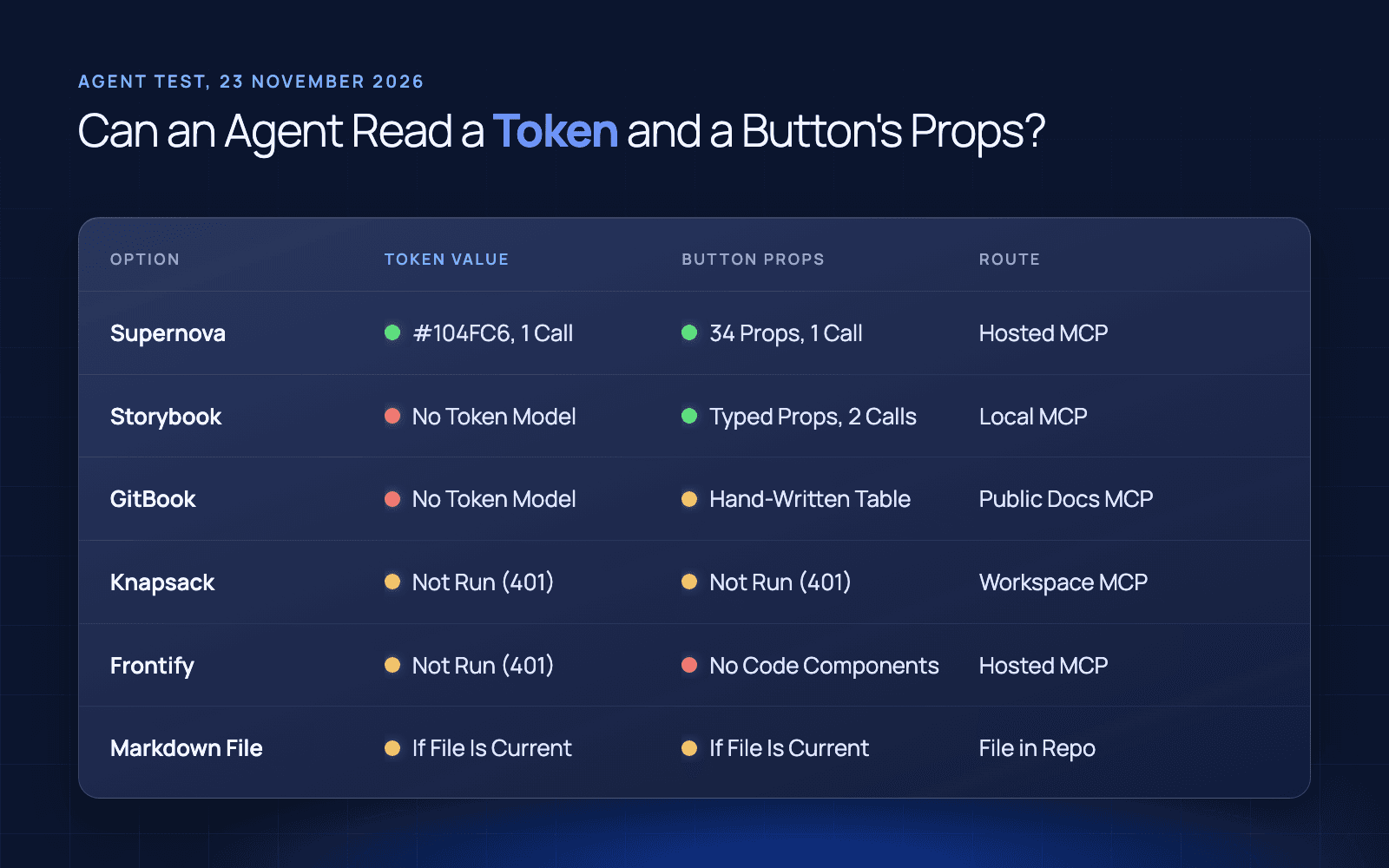
If you are evaluating zeroheight alternatives in 2026, the buying criteria have shifted since your team picked a documentation tool. Engineers now ask coding agents like Claude Code or Cursor to ship UI, and those agents read your design system too. On 23 November 2026, we ran two identical tasks against six options: resolve one token value (the primary background color) and list one component's props (Button), using only what each vendor exposes to agents.
The short answer
- Stay on zeroheight if your documentation is read mostly by people, your docs team ships updates there every week, and your agents stay under 500 MCP calls a month (the cap on Free and Starter plans per zeroheight's pricing page, checked 23 November 2026).
- Switch tools if engineers already build with coding agents and keep getting wrong tokens or invented props. That failure means your system is readable by humans and unresolvable by machines.
How we tested
We ran one agent (Claude Code) through two tasks across Supernova, Storybook, GitBook, Knapsack, Frontify, and a repository markdown file. Each tool used its official agent route: an MCP server, an API, or published pages.
We recorded call counts, returned payloads, and anything missing. Where an MCP endpoint required a customer login we did not hold, we stopped at the 401 response and reported only what was verifiable from outside.
1. Supernova
Supernova stores tokens, components, and documentation as structured entities and exposes them to coding agents over a hosted MCP server. Disclosure first: Supernova is our product, and we ran this test on our own product design system, so weigh the result accordingly.
- Token test: Pass in one call (
sn_get_token_list), returning every color token with its resolved value (Background/Primaryresolved to#104FC6). The agent still had to disambiguate "primary" across three matching roles (foreground, background, and border). - Props test: Pass in one call (
sn_get_code_component_list), returningButtonand all 34 typed props from code, includingvariant: "solid" | "faded" | "outline" | "ghost". Because those props come straight from code, usage prose lives in a separate doc record. - Fit for: Teams whose engineers ship with coding agents and want tokens, component contracts, and documentation resolved from one source of truth.
- Pricing: Flat workspace pricing (not per-seat). Starter is free with 3 editors, 20 public pages, 1 Consumer MCP server, and 1,000 monthly workspace credits. Pro is $399/month billed annually ($499/month monthly) with 10 editors, up to 200 private consumers, 2 Consumer MCP servers, and 10,000 monthly credits; Enterprise adds unlimited editors, consumers, and MCP servers (Supernova pricing, checked 25 November 2026).
2. Storybook
Storybook is the open-source component workshop most frontend teams already run locally. A fresh storybook init on version 10.6.8 installed @storybook/addon-mcp by default.
- Props test: Pass in two calls.
docs-listlocatedButton, anddocs-showreturned full typed props with defaults, comments (size?: 'small' | 'medium' | 'large' = 'medium'), and example stories. - Token test: Fail. Storybook has no native token model; the button's primary color sat hardcoded as
#555ab9in CSS, invisible to the MCP server. - The catch: The MCP server runs only while
storybook devis active on a developer's machine, with no shared hosted endpoint for the rest of the org. - Fit for: Engineering teams that want accurate React component props locally and manage tokens and guidelines in another system.
- Pricing: Free and open source (MIT). Hosted visual review on Chromatic starts free with 5,000 snapshots/month (checked 23 November 2026).
If you want to keep your existing stories while adding hosted tokens and guidelines, read our guide on using Storybook and Supernova together.
3. GitBook
GitBook is a general documentation platform that exposes a read-only MCP server at /~gitbook/mcp for every published site, with no login required on public docs. We tested GitBook's own published documentation because no public design system docs were available there.
- Props test: Partial pass in two calls. Search surfaced an overview page first, and
getPageon theButtonreference returned a hand-authored markdown table. Itsiconrow read'close' | ..., leaving an agent guessing which icon names exist. - Token test: Not applicable. GitBook has no token model, so an agent sees only whatever text someone typed into a page, with zero guarantee it still matches production code.
- Fit for: Teams documenting mostly prose guidance who already standardize product docs on GitBook.
- Pricing: Free for individuals; Essential is $65/site/month plus $12/user/month billed annually, with MCP included on every plan (GitBook pricing, checked 23 November 2026).
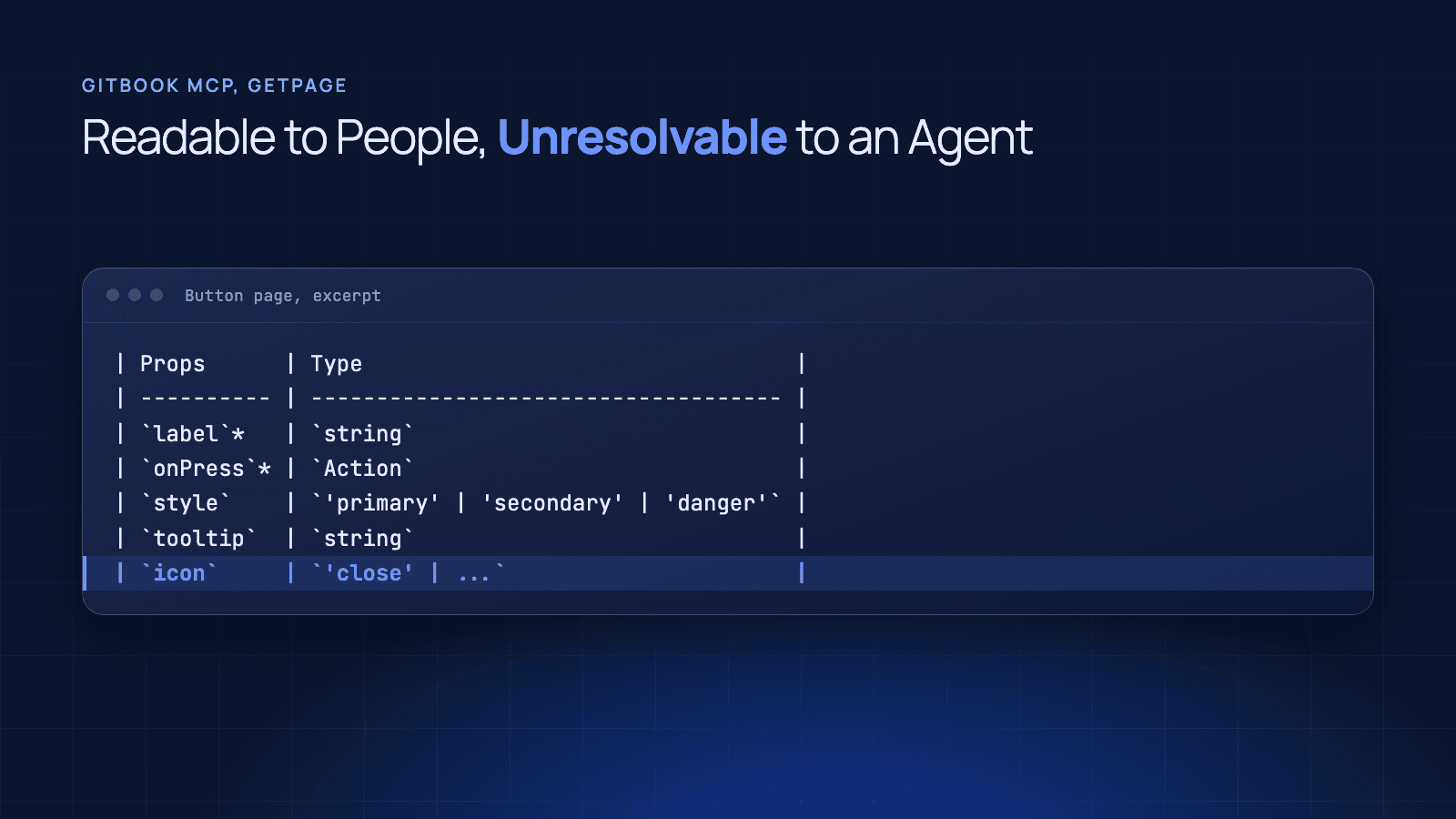
That truncated icon row is the readable-versus-resolvable gap in one line: a person reading it knows to check the icon set, while an agent guesses a name and ships a broken or missing icon.
4. Knapsack
Knapsack is a design system platform linking code, design, and documentation. Each workspace exposes an authenticated MCP endpoint that its documentation describes as giving AI tools live access to tokens, components, and docs.
- Test: Not run. Knapsack's public demo workspace MCP returned
401 invalid_token, and fetching the demo page without JavaScript returned only"Loading". - Fit for: Enterprise design system teams that prefer a sales-led platform rollout.
- Pricing: Not published. Plans start at 5 users on annual contracts with no free trial (Knapsack pricing, checked 23 November 2026).
If your team already holds a Knapsack workspace, run the same two prompts inside it. It is the one enterprise alternative here that likely returns structured data once authenticated, though we could not verify it without an account.
5. Frontify
Frontify is a brand management platform built around brand guidelines, media assets, and marketing templates. Its MCP beta exposes 52 tools focused on brand assets, colors, and typography.
- Test: Not run. The hosted MCP endpoint returned
401requiring OAuth sign-in. - Props test: Not applicable. Frontify's data model covers brand guidelines and creative assets, with no code component prop registry.
- Fit for: Brand and marketing teams whose primary consumers create campaigns and presentations, paired with a separate engineering tool for UI code.
- Pricing: Custom sales quotes priced on monthly active users (Frontify pricing, checked 23 November 2026).
6. Do it yourself: an AI tool and markdown files
The alternative most teams weigh first is zero software: commit a DESIGN.md, AGENTS.md, or scoped Cursor rules for your design system into each product repo and point agents at the files.
- Both tests: Pass by construction, because the agent reads whatever you typed into the repo.
- The catch: Static markdown goes stale the moment tokens or component props change. Writing the first file takes an afternoon, while keeping copies synced across five product repos becomes an unassigned chore nobody owns.
- Fit for: One product team, one repository, and one named owner maintaining the file after every release.
- Pricing: Free in license fees, paid in engineering time. We broke down those hidden costs in build vs buy for a design system platform.
Which zeroheight alternatives work with AI coding agents?
Only tools with a structured token and component model give coding agents resolvable answers across repositories; documentation-only platforms return prose pages that agents still have to interpret.
| Option | Agent route | Token value | Button props | Pricing model (Nov 2026) |
|---|---|---|---|---|
| Supernova | Hosted MCP, signed in | Pass (1 call) | Pass (1 call) | Starter free; Pro $399/mo yearly ($499 monthly) |
| Storybook | Local MCP (storybook dev) | Fail: no token model | Pass (2 calls) | Free, open source (MIT) |
| GitBook | Public docs MCP | No token model | Partial: hand-written table | Free; from $65/site/mo yearly |
| Knapsack | Workspace MCP, signed in | Not run (401) | Not run (401) | Contact sales, annual (5+ users) |
| Frontify | Hosted MCP, signed in | Not run (401) | No code components | Contact sales (MAU pricing) |
| Markdown files | Files in product repo | Pass if current | Pass if current | Free (manual upkeep) |
| zeroheight (baseline) | Hosted MCP, signed in | Pages only | Pages only | Free; Starter $49/editor/mo yearly |
The zeroheight baseline comes from @zeroheight/mcp-server 2.10.2 (list-styleguides, list-pages, and get-page) and zeroheight's pricing page (checked 23 November 2026). Ask zeroheight's MCP about a token and it hands back the documentation page mentioning that token; for the head-to-head feature breakdown, see Supernova vs zeroheight.
What actually moves when you leave zeroheight?
Plan for three buckets of migration work before picking a replacement so switching costs stay predictable:
- Moves cleanly (hours): Figma libraries and variables reconnect directly to Supernova or Knapsack; standard W3C DTCG JSON tokens and repository code components import without re-authoring.
- Needs light cleanup (days): Written guidelines export as Markdown or copy cleanly, though zeroheight-specific embeds (live previews, custom callout blocks, and Figma frame grids) must be remapped to the new platform's blocks.
- Requires team cutover (one sprint): Repoint your custom docs domain, set 301 redirects for top bookmarked component URLs, and swap the MCP server URL in
.cursor/mcp.jsonor Claude Code so agents query the new endpoint.
When zeroheight is still the better choice
Switching platforms costs focus, and some teams get zero return from moving right now. Stay on zeroheight if:
- Your consumers are mostly people: Designers and product managers read guidelines, while engineers read code directly.
- Your docs workflow is healthy: Your writers ship updates quickly in zeroheight and pages stay current.
- Agent usage is minimal: A small group of engineers stays comfortably below 500 MCP calls a month.
When teams outgrow page-only docs, rigidity usually forces the move. Hospitality software company Mews left zeroheight because it "felt a bit too rigid and inflexible for our needs," detailed in the Mews design system case study.
Run the ten-minute test before you pick one
Skip vendor feature grids and run our two prompts on your own system. Ask your coding agent for one semantic token value and one production component's props through each finalist, then count every wrong value or missing prop.
For the broader buying checklist beyond AI agents, read how to choose a design system platform. If you want to test how Supernova resolves your own tokens and components, start on the free Starter plan.
Give your agents a system worth following
See how Supernova documents, syncs, and serves your system in one place.